Department of English Studies, Tai Solarin University of Education, Ijagun, Ijebu-Ode, Nigeria
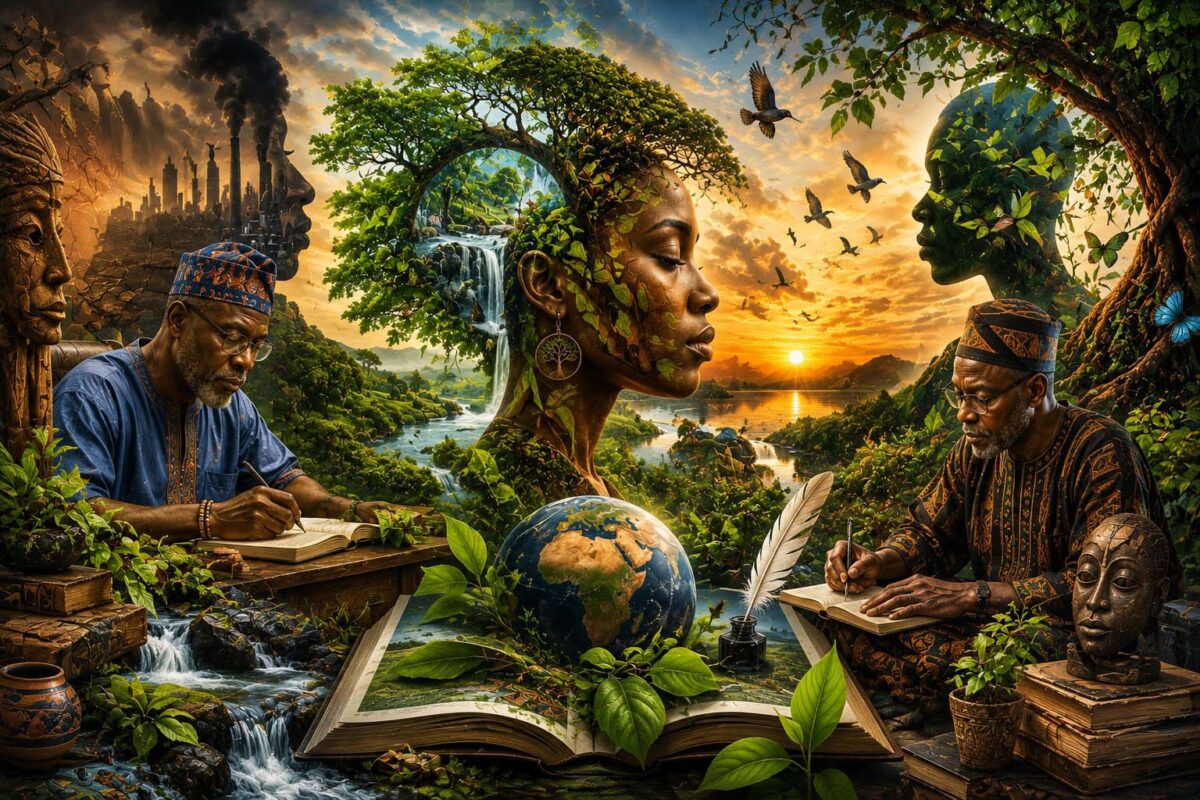
Literature is perceived as the production of a literary work or a body of written works produced in a particular language, country or age. It is conceptually viewed as a mirror of life or life itself as it is primarily concerned with all those things that deal with life. It is also considered as a portrait of man and his environment, held up for him to be seen by the artist, so that he can have profound reflections about his life, the world and that of the generation in which he belongs. Part of the components of life is the environment, which is a segment of nature. The literary environmentalist, as an eco-critic, is preoccupied with the study of nature and the environment. Eco-criticism perceives nature as the hub on which human being and its environment rotate. As a study that deals with the relationship between literature and the physical environment, eco-criticism usually adopts an earth-centred approach to literary studies. Eco-criticism views the earth as a natural aesthetic endowment with its values, (i.e. landscape – fertile and desert lands – seas, oceans and rivers, the green vegetation, mountains and rocks, valleys and highlands and other phenomena that constitute the environment); all of which contribute positively to man‟s existence and sustenance. It is a literary writing in which the eco-writer/poet delves into issues of environmental concern and particularly the effect of pollution on nature. Eco-criticism‟s major pre-occupation, as exemplified in the various writings of the eco-writers/poets/critics, is to condemn the atrocities usually perpetrated by man to nature, which, in the main, have penurious effects on the same man. The concern of the eco-writers/poets/critics corroborates Adie Edward‟s position that “the world‟s attention has been drawn towards the urgent need for the preservation of and maintenance of the environment as it is faced with the daunting phenomena called global warming and environmental degradation” (2019:18). In this paper, an eco-critical analysis of selected poems of Niyi Osundare and Tanure Ojaide is done, with a view to using their poems as a clarion call on government and other concerned agencies for necessary repair to the unjustifiable damage done, and are still being done to the Niger-Delta zone of Nigeria and other places negatively affected. The damage, which is of high magnitude and unquantifiable, is the major pre-occupation of the literary environmentalists. This paper therefore posits that man should stop its maltreatment of nature. Nature should be treated as a phenomenon without which man‟s existence can be in jeopardy.
Literature, Literary environmentalist, Eco-criticism, Nature, Eco-poetry