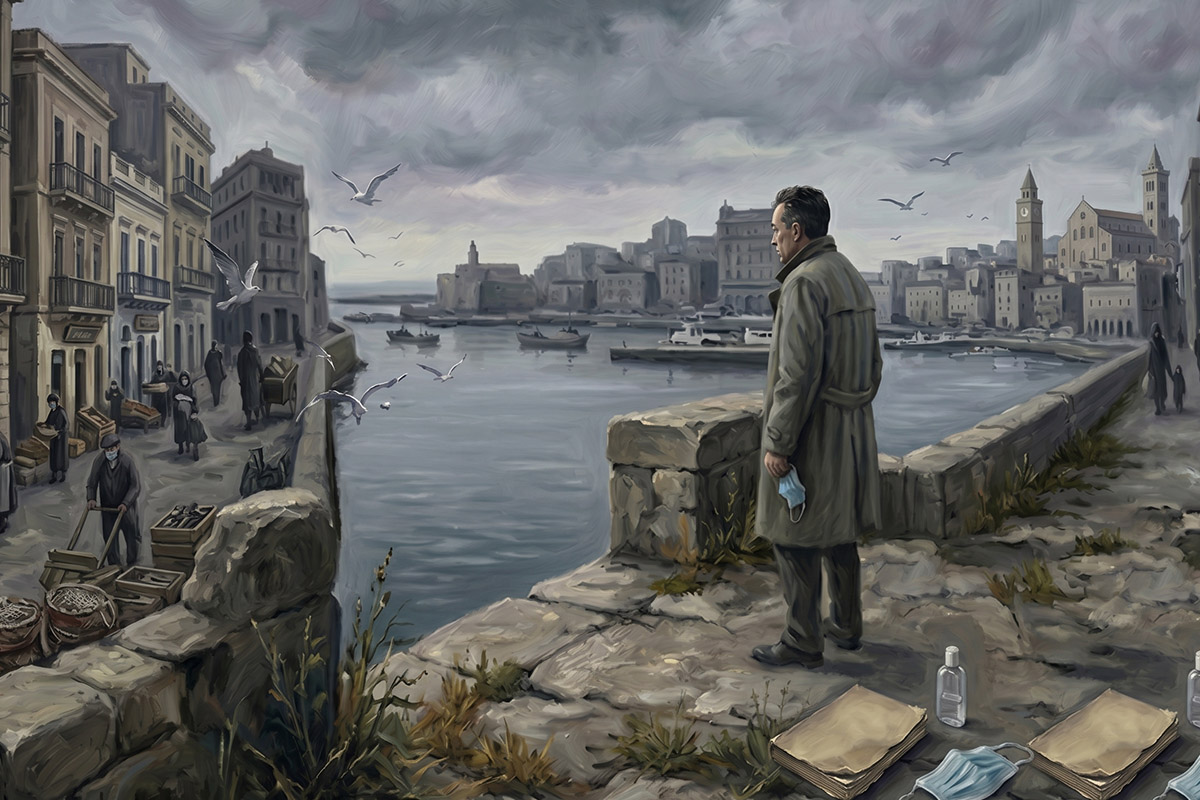
Vers le discours de l’essence de la vie devant la pandémie de Covid-19: une évaluationde la philosophie de l’absurde dans La peste d’Albert Camus
Peter Akongfeh Agwu & Tolbert Terdue Abutu
Department of Modern Languages and Translation Studies, Faculty of Arts and Humanities, University of Calabar, Calabar & Department of Modern Languages, Faculty of Arts and Humanities, Federal University, Lafia, Nassarawa State, Nigeria
In the 21st century, researchers have continued to seek valid explanation for societal ills that confronts mankind such as: terrorism, pandemics, or plagues, food and generalized insecurity, existential conflicts, yet little or no valid reason have justified these occurrences. This discourse examines Albert Camus’s position with regard to his philosophy of the absurd in The Plague (1947). The aim of the study is to evaluate the contemporary absurd world caused by the Covid19 virus which has continued to claim victims either by death or by the loss of millions of jobs till date. Premised on the above, Camus and other philosophers such as Sartre, Slimani, and Levé begins to reflect on human existence and its fundamental value by asking why life has lost all meaning. The answer to this malaise is found in a sentence that Camus calls the absurdity of the man who lives for nothing in a meaningless world. The study is rooted in Sigmund Freud’s psychoanalytical theory and Emile Durkheim’s sociological frameworks to textually analyze the indifference and unbalanced of the characters and the predicament that befall mankind in The Plague, as presented Camus in the novel. The study’s extraction is to attempt to explain possible reasons why the Covid-19 virus is presumed to be man-made in a bit to threaten the world and an entire generation. An evaluation of all these shall aid the study to reach possible conclusions about the essence of human existence on earth.
Covid-19, Essence of life, Philosophy of the absurd, Pandemic, 20th century